
Like any food-processing activity, the preserve-making industry generates waste and by-products that have long been managed inefficiently. The circular economy proposes a change of approach: instead of seeing that waste as a problem to get rid of, it treats it as a resource to make the most of, rethinking the full life cycle of every material involved in the process. At Conservas Rías Baixas we actively take part in this shift through the SIMBlue project, and in this article we explain what it involves.
What the circular economy means for the sea-based industry sector
The circular economy aims to close the loop on materials and resources within a production process, reducing as much as possible the waste that ends up being discarded with no further use. In the sea-based industry sector, this means looking for new uses for the by-products generated during preserve-making, rather than simply treating them as waste that needs to be managed and disposed of.
This approach makes sense both environmentally and economically: it reduces the impact of preserve-making activity on the environment and, at the same time, can open up new sources of value from materials that previously had no further use. It’s a way of understanding production that is starting to spread across the whole Galician sea-based industry sector, driven both by environmental regulation and by companies’ own growing interest in optimising their processes.
The SIMBlue project: industrial symbiosis for the sea-based industry sector
SIMBlue, whose full name translates as Industrial Symbiosis Tools for the Sea-Based Industry Sector, is a project in which we collaborate with Esquío Ingeniería, Anfaco and other institutions and private companies, under the Nexos 2025 programme. The aim of this tool is to optimise and make use of the waste generated in the sea-based industry sector, promoting precisely the circular economy and environmental care.
- Identifying waste and by-products generated during the preserve-making process.
- Finding new uses or applications for those materials.
- Collaboration between companies and institutions in the sea-based industry sector.
- Using real facilities as a pilot plant to validate solutions.
As part of this project, Conservas Rías Baixas has made our own facilities available to the consortium’s technical team, so they can be used as a pilot plant for developing and validating these industrial symbiosis tools.
Why we take part in projects like this
Taking part in SIMBlue responds to an idea that runs through much of our commitment to sustainability: a Galician preserve maker with more than a century of history has a particular responsibility towards the environment it depends on. You can learn about other related initiatives, such as the ozone cleaning system at our factory or the installation of solar panels, on our environmental commitment page.
Collaborating with technology centres such as Esquío Ingeniería and with sector organisations such as Anfaco allows us to tackle these challenges with technical knowledge that would go well beyond what a single company could develop on its own. The circular economy, applied at a real scale, needs exactly this kind of collaboration between different players in the sector.
Other initiatives alongside the circular economy
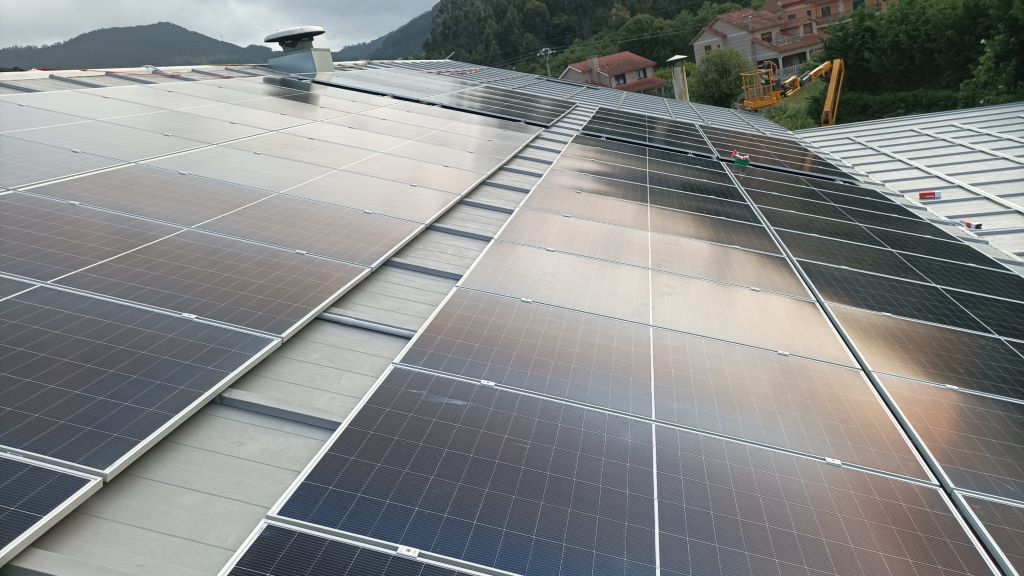
SIMBlue isn’t Conservas Rías Baixas’s only initiative in this direction. At our factory in Moaña we have also installed solar panels in partnership with Helexia — a 158.8 kWp installation with 267 panels that covers around 81% of our energy consumption, generating roughly 214 MWh a year and avoiding the emission of close to 79.93 tonnes of CO2 equivalent. It’s another piece of the same commitment: reducing the environmental impact of our activity without giving up the production capacity we need to keep making quality preserves.
Together with the ozone cleaning system introduced in our industrial hygiene processes, these initiatives form a production model that aims to move forward on several fronts at once: less waste, fewer chemicals, fewer emissions, and a smarter use of available resources.
The road still ahead
Projects like SIMBlue are one step within a longer process of transforming the sea-based industry sector towards more sustainable, circular models. They aren’t a definitive solution, but they are proof that it’s possible to rethink the management of preserve-making waste from a different perspective, finding value where before there was only seen a problem.
If you’d like to know more about how we understand sustainability at our factory, visit our facilities section, and if you’d like to see the final result of our work, don’t miss our online preserves shop. In the end, the circular economy is also part of what lies behind every can.
If you’d like to know more about the SIMBlue project or any of our sustainability initiatives, you can write to us through our contact page. We like to openly share the steps we’re taking towards a more circular, more responsible production model.