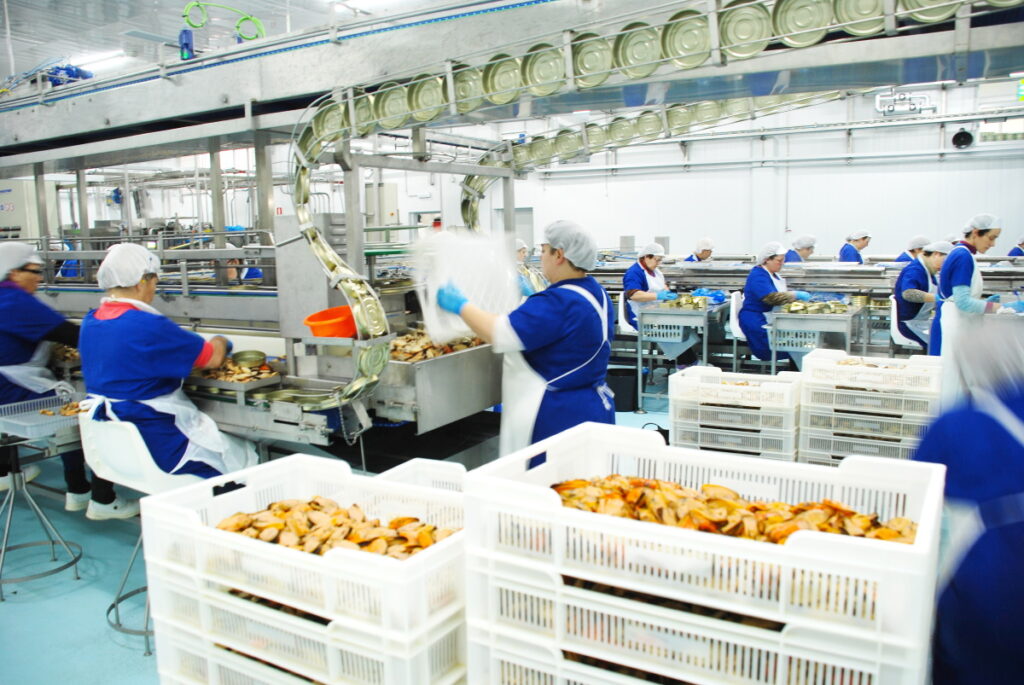

Many people assume that a preserve stays in good condition for years solely thanks to preservatives, when in reality the true driver behind that preservation is vacuum packing combined with an appropriate thermal process. In this article we explain what vacuum packing involves, what role it plays in food preservation, and why it’s a key element in any quality preserve, including the ones we make at Conservas Rías Baixas.
What vacuum packing is and how it works
Vacuum packing involves removing the air from inside the container before it is sealed, so the food is left in an environment that is practically free of oxygen. This absence of oxygen is crucial because many of the microorganisms responsible for food spoilage need oxygen to develop, so removing it significantly slows down their ability to multiply.
In the case of canned preserves, vacuum packing is combined with a fully airtight seal and, afterwards, with a thermal treatment in the autoclave that eliminates any microorganisms that might remain inside. This combination is what allows a well-made can to keep in perfect condition for years without refrigeration or added preservatives.
Why vacuum packing is key to food preservation
The role of vacuum packing goes beyond extending the product’s shelf life. By reducing the presence of oxygen, it also slows down the oxidation processes that affect the colour, flavour and texture of food over time. This means a well vacuum-packed preserve isn’t just safe — it also keeps its organoleptic qualities better throughout its shelf life.
- Removes the oxygen that encourages microbiological spoilage of the food.
- Slows down the oxidation processes that affect flavour and colour.
- Allows the product to be kept for long periods without refrigeration.
- Combines with the thermal treatment to guarantee food safety.
How this process is applied at a preserve factory
At a preserve factory, vacuum packing is part of a sequence of steps that includes cooking the product, placing it in the container, removing the air, sealing it airtight and, finally, the autoclave process. Each of these stages must be carried out precisely, because a failure at any one of them can compromise the final preservation of the product.
At our factory in Moaña we have specific packing and closing lines to guarantee that this process is carried out correctly for every batch, along with large-capacity autoclaves that complete the sterilisation process. You can learn more about how our factory is organised in our Conservas Rías Baixas facilities section.
Vacuum packing versus other preservation methods
There are other ways to preserve food, such as refrigeration, freezing or chemical preservatives, and each has its own advantages and drawbacks. Vacuum packing combined with thermal treatment has the particular feature of not relying on a constant cold chain or on added additives, which greatly simplifies both transport and storage of the product, for the company and for the buyer alike.
This independence from the cold chain is one of the reasons canned preserves remain such a valued format: it allows access to quality fish and shellfish at any time of year, without the logistical limitations of fresh products, while still maintaining a very high level of food safety thanks precisely to vacuum packing and subsequent sterilisation.
What this means for the person eating the preserve
Thanks to vacuum packing, you can keep a can of preserves in your pantry for a long time without worrying about safety or any noticeable loss of quality, as long as proper storage conditions are followed. It’s one of the reasons preserves remain such a practical, reliable format for enjoying quality fish and shellfish at any time.
If you’d like to see for yourself, discover our selection of preserves in our online shop, and if you’re looking for ideas to make the most of them, visit our recipes with Galician preserves section. Behind every well-preserved can lies a packing process designed with far more care than meets the eye.
If you have questions about how to store or use any of our products, you can write to us through our contact page. We like to clearly explain the process behind every can, because understanding how a food is preserved also helps you enjoy it more.